This page provides evidence, tools, and messages to support our advocacy partners in driving this agenda forward. Together, taking action that can save millions of lives in the years to come.
Demand action on high blood pressure
Join Resolve to Save Lives and leaders from around the world as we call for committed, urgent, and coordinated action to protect one billion hearts.
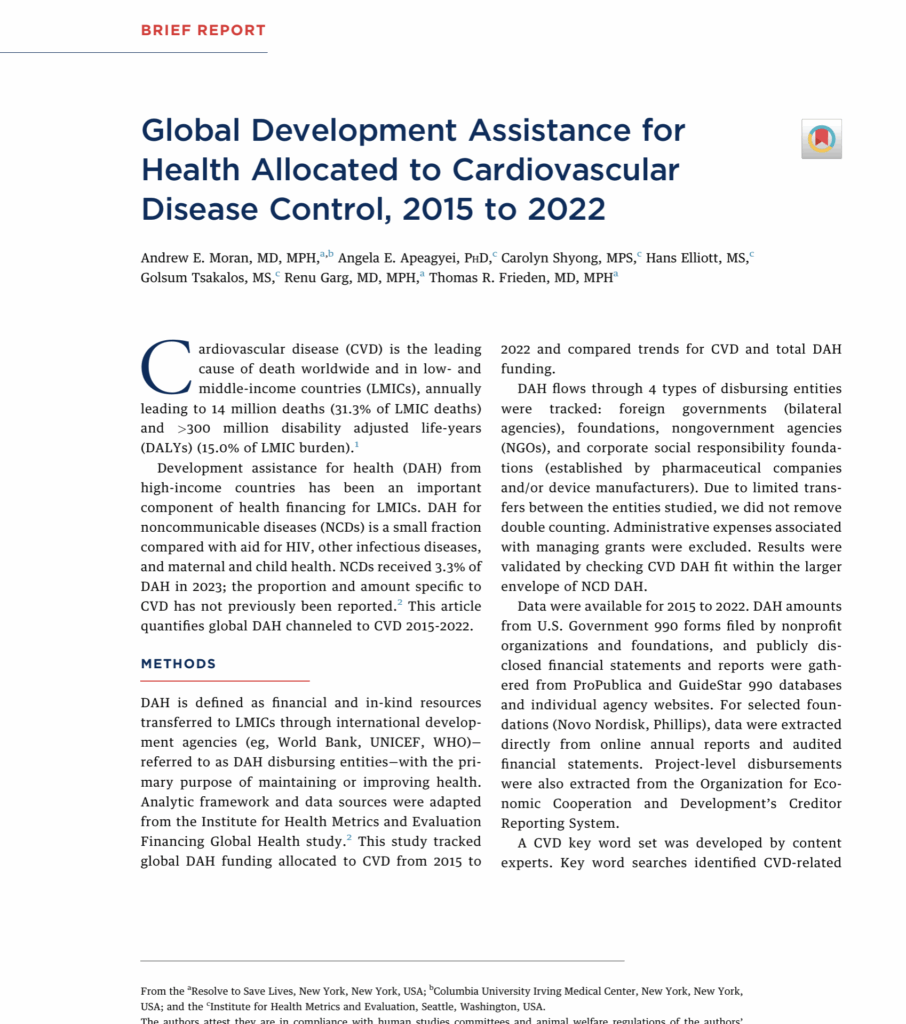
A new landmark report in the Journal of the American College of Cardiology quantifies for the first time the surprising mismatch between high CVD burden and low CVD funds from high income country governments and international development agencies.
Despite accounting for roughly 31% of total mortality and 15% of total disease burden in low- and middle-income countries (LMICs), just 0.1% of global health funding (or one in 1000 dollars) is dedicated to controlling CVD. Read the full report here.
Taking action at UNGA 2025
Resolve to Save Lives, the World Health Organization, and Bloomberg Philanthropies came together with global health leaders during UNGA to launch WHO’s second global hypertension report, which identifies access to life-saving medicines as the biggest barrier—and the greatest opportunity—for rapid, scalable progress to get high blood pressure under control and saving millions of lives.
During the event, speakers—including WHO Director-General Dr. Tedros Adhanom Ghebreyesus—underscored the urgency of expanding access to medicines, while leaders from Ethiopia, the Dominican Republic, Indonesia, and the Philippines shared how they are proving that large-scale blood pressure control is possible.
Watch the full event recording to gain insight into the latest global data on high blood pressure and the evidence-based tools we have to get it under control.